Where cultures converged: Quanzhou's maritime legacy
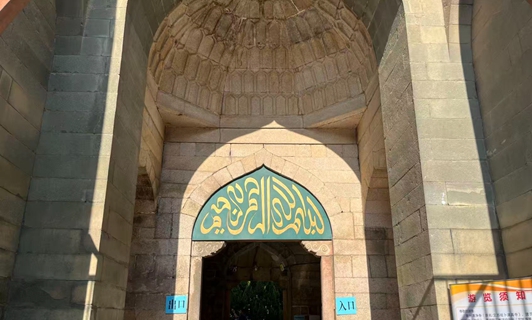
The main gate of the Qingjing Mosque. [Photo/Fujian Daily]
During the Song and Yuan dynasties (960-1368), Quanzhou emerged as the "World Maritime Trade Center" and the "Largest Oriental Port". This period saw the city develop a complex maritime culture influenced by policies, economy, technology, religion, and immigration.
A significant influx of Arabs and Persians brought diverse cultures and religions, including Buddhism, Christianity, Hinduism, and Manichaeism. They also introduced new architectural styles, mathematics, and astronomy to Quanzhou. Among the city's historical landmarks, the Qingjing Mosque and Cao'an Temple stand as unique symbols of cultural integration.
The Qingjing Mosque, nearly a millennium old, exemplifies this cultural fusion. Located near the Guanyue Temple and Confucius Temple, it symbolizes the harmonious coexistence of diverse traditions. Its main gate, crafted from bluish and white granite, features a three-tiered pointed arch dome and a rooftop adorned with traditional Chinese lotus patterns, reflecting the blend of Chinese and Arab cultures.
Quanzhou's role as a vital hub on the Maritime Silk Road is evident in its vibrant Muslim community. Merchants from Arab, Persian, and Central Asian regions established multiple mosques, engaging in trade and religious activities that fueled the city's prosperity.
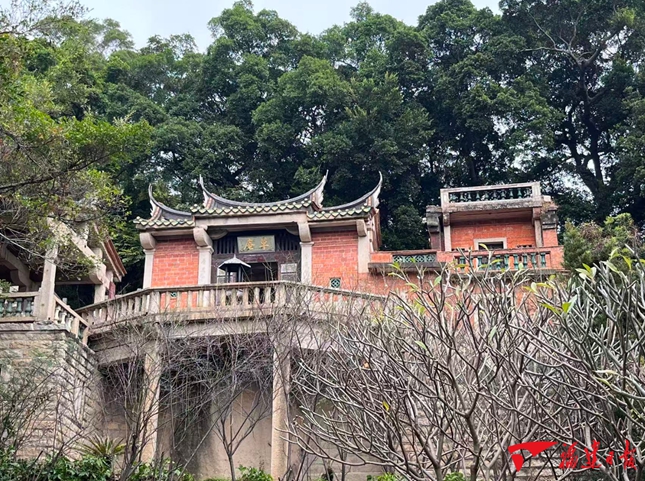
The Cao 'an Temple is built against the mountain and beside the cliff. [Photo/Fujian Daily]
Cao'an Temple, originally constructed with thatch during the Shaoxing reign (1131-1162) of the Song Dynasty (960-1279) and later rebuilt with stone in the Yuan Dynasty (1271-1368), is one of Quanzhou's oldest public Buddhist sites.
The temple is notable for its Statue of Mani Buddha, offering vital evidence of Manichaeism's spread in China. This ancient religion, founded in the mid-3rd century by the Persian prophet Mani, merges elements of Zoroastrianism, Christianity, and Buddhism.
In 1996, the stone carving at Cao'an Temple was designated a national key cultural relic. In 2021, the Statue of Mani Buddha at Cao'an Temple was inscribed on the UNESCO World Heritage List as part of "Quanzhou: Emporium of the World in Song-Yuan China", making it China's 56th World Heritage site.